Thank you to everyone who responded to my last email with well wishes and kindness! I think a break is definitely needed while I deal with all the other work on my plate, but I’m writing this special issue because I’d like to document some stuff today while the memory's still fresh.
Contrary to popular assumption—and the police and mainstream media’s narrative about my “numerous run-ins” with the law—I’ve never been charged for anything before now, so today has been full of new experiences.
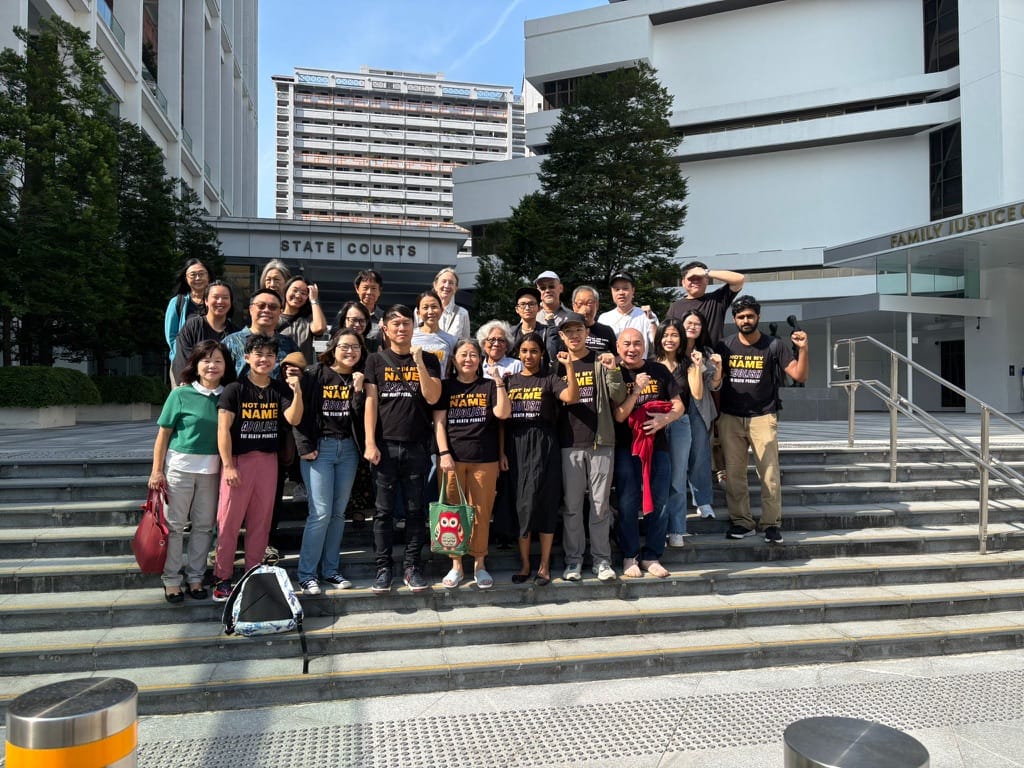
As mentioned in a previous weekly wrap, I’ve been charged with one count of “taking part in a public assembly within a prohibited area” because in 2025 I participated in taking group photos outside the State Courts while some friends and I wore anti-death penalty T-shirts. My first court mention was this morning, alongside Rocky Howe, Kokila Annamalai, Neo Swee Lin, Lim Kay Siu, and Jeanne Ten. The first four were also charged for the same photo-taking (with additional charges for Rocky for participating in vigils for death row prisoners in 2024 and 2025), while Jeanne was charged for attending vigils in 2024.
T-shirt also can drama
There was fuss even before we made it into the courthouse. Security officers, surrounded by press photographers and videographers, intercepted us as we approached the entrance to the State Courts and said that, per instructions from “management”, those of us wearing T-shirts with symbols or slogans would not be allowed to enter the building. I was wearing a Readers and Writers Against the Genocide shirt, while Koki and another TJC member were wearing Labour Day T-shirts, and Elijah was wearing a shirt that said “Down with Bureaucratic Capitalism”.
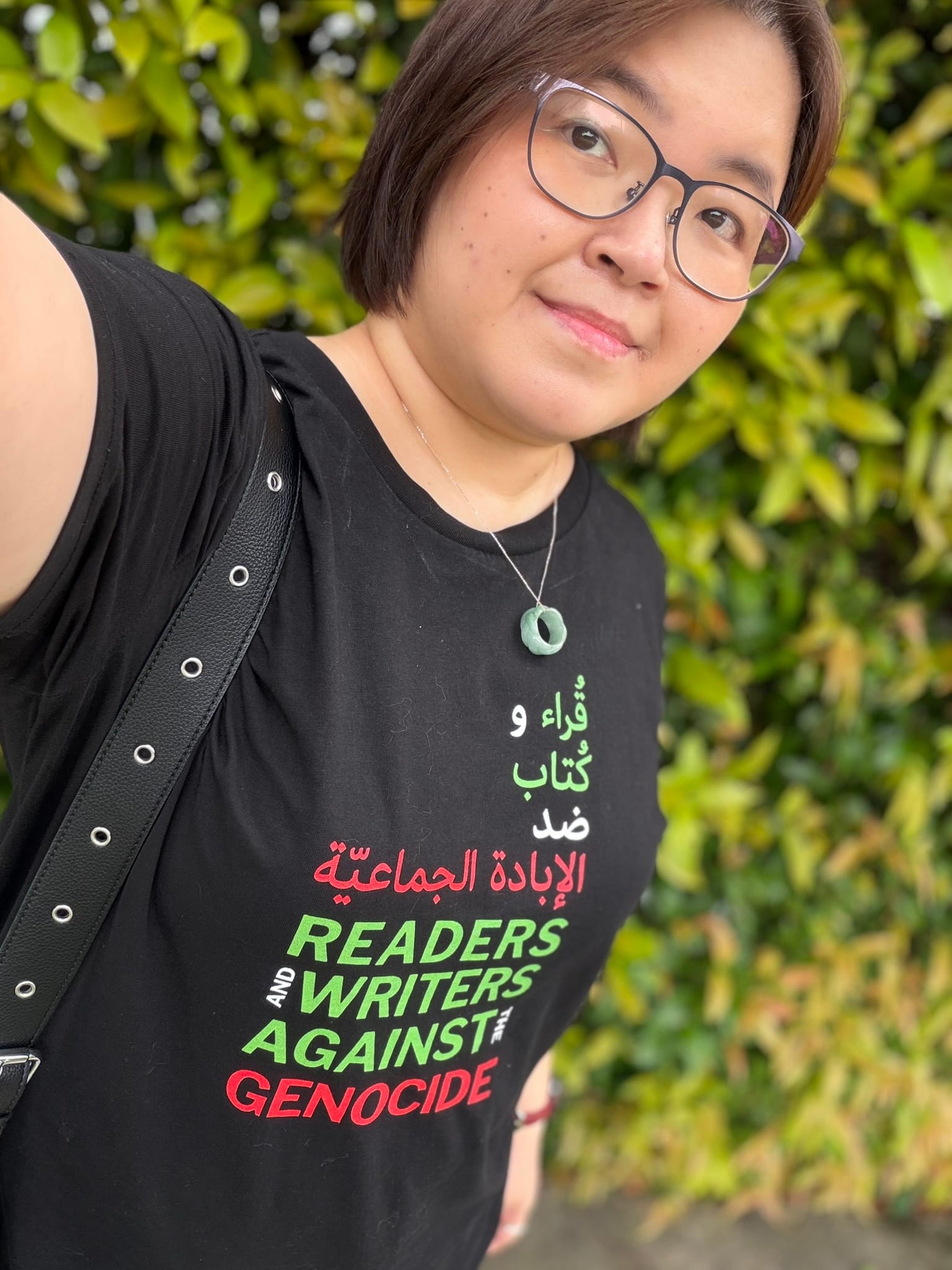
We asked the officers if they could show us the laws or regulations stating that such shirts are banned from the building, but they weren’t able to do so. They just kept saying again and again that management had issued instructions that we weren’t to be allowed in unless we changed our shirts or covered up the slogans somehow, like by putting on a jacket.
I had a rainbow keffiyeh that I wrapped around myself, covering my T-shirt, and the guards said this was acceptable. But by the time we rounded the corner and got to the security scanners just inside the building, another guard said it had been decided that this was not good enough, after all. We pointed out how inconsistent this was with the instructions we’d been given just minutes ago, but he wouldn’t budge. By that point, we were already late for our court mentions, so three of us women ended up taking our T-shirts off right there in front of security and turning them inside out. (Good thing I was wearing one of my newer and nicer bras, I guess.) We were then finally allowed to go through security and head up to Court 4B.
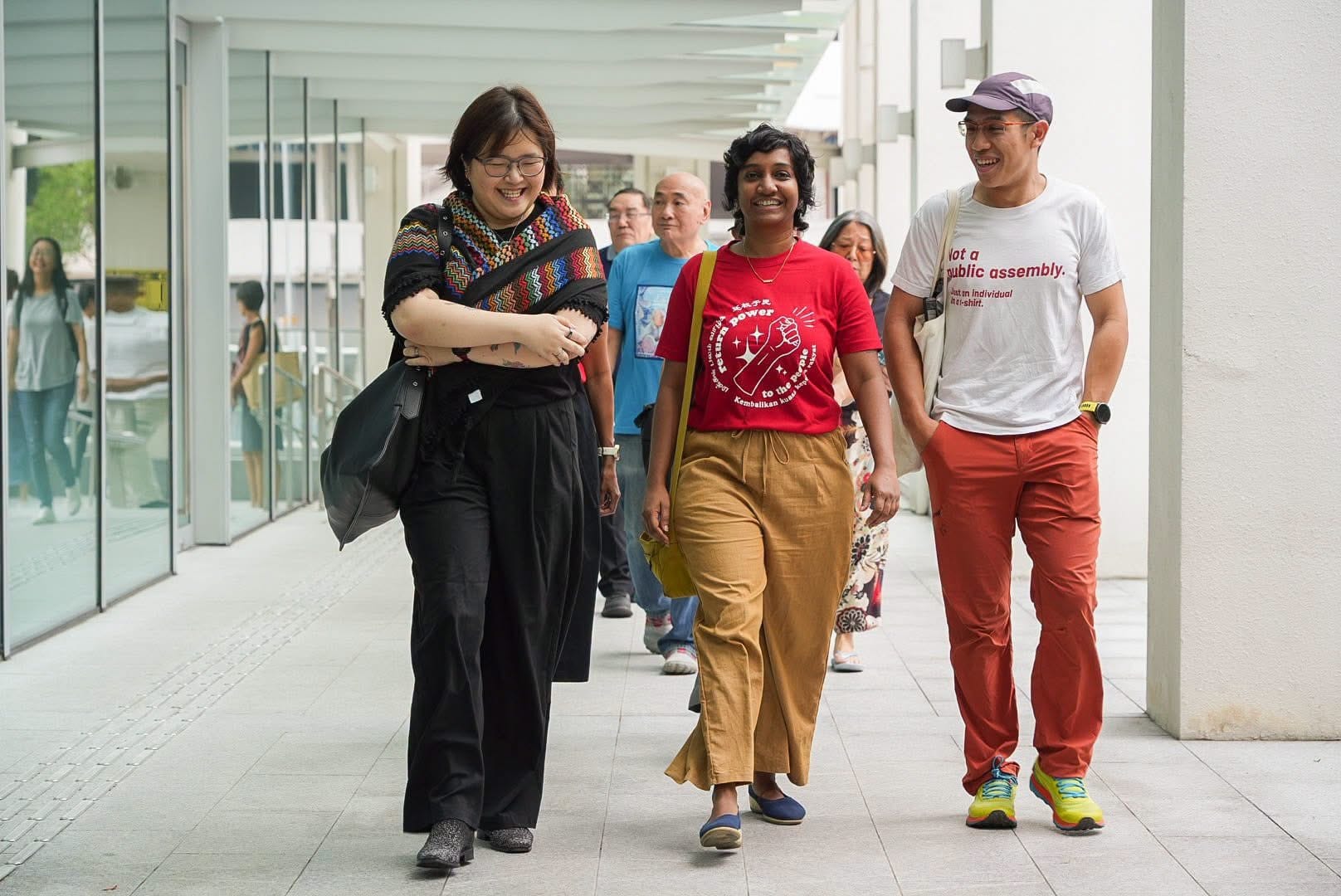
BUT! Once we got up to Level 4, another officer told Rocky—whose “Not a public assembly just an individual in a t-shirt” top had previously been declared not a problem—that his T-shirt was a problem after all, and that he wouldn’t be allowed to enter the courtroom wearing it. The officer kept saying that it was “inappropriate”, but couldn’t explain what was inappropriate about it. At one point, I overheard him telling Rocky that “the shirt says ‘not a public assembly’…” only to trail off, presumably because he couldn’t articulate what the issue was with that. In the end, Rocky turned his shirt inside out, too.
Cuffs and shackles
I’ve been to Court 4B multiple times now, and it felt quieter than usual today. We were called up pretty quickly. Attempts were made to argue that we should be released on personal bond—on the grounds that the charge is for an offence where the penalty is merely a fine—but the judge refused and stipulated bail sums of $5,000 each. We were also required to surrender our passports, so we’ll have to seek permission from the court whenever we want to travel.
While our bailors headed to the bail centre, we were cuffed with our hands in front of us while we sat in the dock. A little later, we were moved to a holding area where we told to face the wall while our cuffs were traded for shackles—this time, our wrists were restrained behind our backs, with a chain connecting the handcuffs to cuffs around our ankles. We were asked to confirm details like our names, IC numbers, whether we were pregnant or had any medical conditions, whether we’d travelled out of the country recently, the numbers we wanted to register for the two phone calls we were entitled to, and (this one I don’t get) whether we’ve had manicures and/or pedicures.
After this, we were escorted, while in shackles, to a lift, where we were once again told to face the wall as we headed to the women’s lock-up. Once there, our shackles were traded for handcuffs. We were required to surrender personal effects; in my case: my watch, my necklace, my rings, my earrings, my keffiyeh, my IC. This was all put in a plastic bag that was later sealed and stowed in a locker that I was told could only be opened with my thumbprint. We were photographed and also given thorough rub-downs: an officer ran her hands over my body from the top of my hair down to my ankles, even checking under the band of my bra and the waistband of my trousers and underwear. (She’d wanted me to completely remove the drawstring of my trousers but relented when I said I had no idea how I would rethread it afterwards.) I was asked to take off my shoes and socks to make sure there wasn't anything hidden in there. She looked inside my mouth. My glasses were inspected for the third and last time.
Girlypop cells
After depositing our things in the lockers, we were escorted to our cells. I don’t know if this is the usual protocol, but the women’s lock-up was empty enough for us to be confined to one cell each. Because we were not only assigned female at birth but also in custody, the doors and bars of the women’s cells were painted pastel pink. (I’ve confirmed with the guys that the doors and bars of the men’s lock-up are painted blue!)
The pinky-pink decor ends at the door, though—the rest of the cell is nothing to write home about. Concrete floor, a squirty sink, a toilet bowl behind a half-wall. A CCTV camera in the corner; there’s zero privacy (or toilet paper) if you do actually want to pee or take a dump.
Once in the cell, we were asked to stick our wrists through a hatch in the door so the cuffs could be removed. Then there was nothing to do but play the waiting game. Or, if you have a weird journo/writer brain like me, sit on the floor and absorb as many details as possible while thinking about the STORY you’re going to write once you get home. There was also time to space out a little bit and admire my sparkly ankle boots, which I should really wear more often. And, because I figured that I was already in lock-up and couldn’t be double locked-up, I flipped my T-shirt back around.
(I had no idea that, while I was sitting in a cell twiddling my thumbs, my mum was in the bail centre digging through my wallet looking for anything that might have my address on it, spilling the K-pop photocards I stuffed in there and forgot about over the desk in the process. She apparently then blurted out, “Those are not her ex-boyfriends, she just likes Stray Kids!” Such is my life, losing aura points via friendly fire even while locked up 😮💨 Thanks Ma, love you 🫶🏼)
Lunch was served but I wasn’t hungry so I had to give my box back (turns out cannot tapao). At one point we had to sit cross-legged on the floor of our cells for muster check, which I knew was a thing that happens in prison itself but wasn’t expecting for lock-up.
Wait, wait, wait, paperwork, paperwork, processing, release. I estimate that I was first cuffed at around 10:30am, and was escorted out of lock-up and the courthouse at around 1:20pm. Things took longer for a couple of others because in one case the original bailor was rejected (so another had to be found), and in another the bailor had to first see a judge and answer some questions. These last two were released at about 3:30pm.
Reflections
It seems surreal, but mostly ridiculous, that we had to go through all this because of small vigils outside Changi Prison or taking photos outside the State Courts. It’s utterly disproportionate. And this is even without factoring in the nonsense about our T-shirts this morning, where it felt as if the rules were completely arbitrary and being made up on the spot.
It was unsurprising, but nonetheless disappointing, that so many members of the press were there from early in the morning to get photos and video footage, yet, as far as I saw, not a single one bothered to come up to any of us to ask a question or get a soundbite. The news reporting was entirely drawn from the police’s press release (which is misleading and inaccurate, more below) and what was said in court. As a journalist myself, it doesn’t make sense to me that these guys were already there, sticking their cameras in our faces, and didn’t even try to at least get a soundbite. It really goes to show how lazy and subservient the local media outlets are, content to regurgitate government narratives without doing their own checks or trying to get anything different or extra.
For the most part, I approached today with curiosity rather than fear or panic. I’ve been to court many times over the years, spoken to people who have experienced incarceration, and written about prison conditions and the criminal punishment system, but never got to see this part of the process, so strangely enough this felt like an opportunity to observe, learn, and report. But I’m also acutely aware of the privilege that allows me to adopt this attitude: I have a lawyer and a bailor, and friends I know would have jumped in to help if anything cropped up during the bail process. It was boring sitting in lock-up with no phone no book no music, but I also had the assurance that this was the worst it was going to get for me, because it was only a matter of time before all the paperwork would be complete and I’d be allowed to go back to my regular life.
This is not the case for many people who come into conflict with the law, especially those who are working class or migrant workers. In such cases, it might not be so easy to find someone who will stand surety. This is particularly difficult for migrant workers because bailors have to be either Singaporeans or Permanent Residents, and are often expected to have some existing relationship with the accused person. Who does a worker from Bangladesh or Indonesia or China or India know who would fit the bill? Without a bailor, those charged for offences are locked up in remand as the criminal punishment system runs its course.
That’s a wholly different experience from being locked-up in a cell with a pink door for a couple of hours.
Addendum: Too bad I can't POFMA the police press release
On 27 September, the Singapore Police Force issued a press release that's been dutifully picked up by local mainstream media outlets. This is what the police said about me:
Five persons, aged between 31 and 70 will each be charged with one count of participating in a public assembly in a prohibited area under Section 15(2) of the Public Order Act for gathering outside the State Courts, a Prohibited Area on 3 February 2025. Two members of this group have multiple brushes with the law in relation to Public Order Act offences and have either been warned by the Police in the past:
a. Of the two, the first person is a 37-year-old woman who has had numerous run-ins with the law:
i. Public assembly without a permit on 13 July 2017, 29 March 2022, 26 April 2022;
ii. Obstruction of course of justice under Section 204A(a) of the Penal Code on 29 March 2022 and 26 April 2022; and
iii. Public procession from Novena MRT to the Ministry of Home Affairs on 7 June 2024
For her participation in these various public assemblies/procession, she faced penalties ranging from stern warnings to a 12-month conditional warning.
Firstly, it is incredibly misleading to write about these "numerous run-ins with the law" as if I'm guilty of all of them when I was never even charged for them in the first place. As the warnings that I received clearly state, they do not amount of convictions or findings of guilt! Because I was never charged, there was never any attempt to secure convictions for these alleged offences, and I was never given an opportunity to defend myself in court. (Also, since it has been established that warnings have no legal weight, it's also stretching it to refer to them as "penalties".)
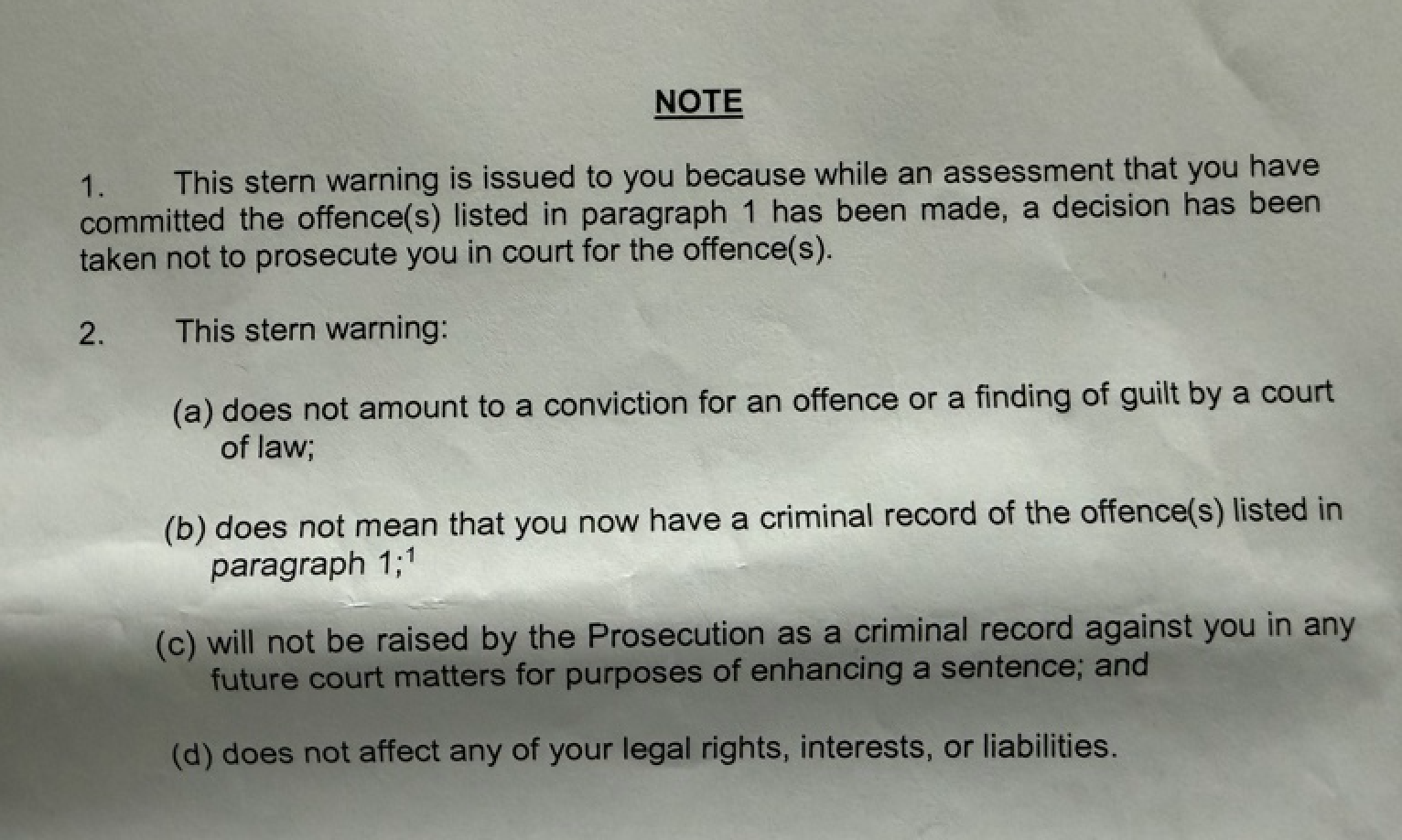
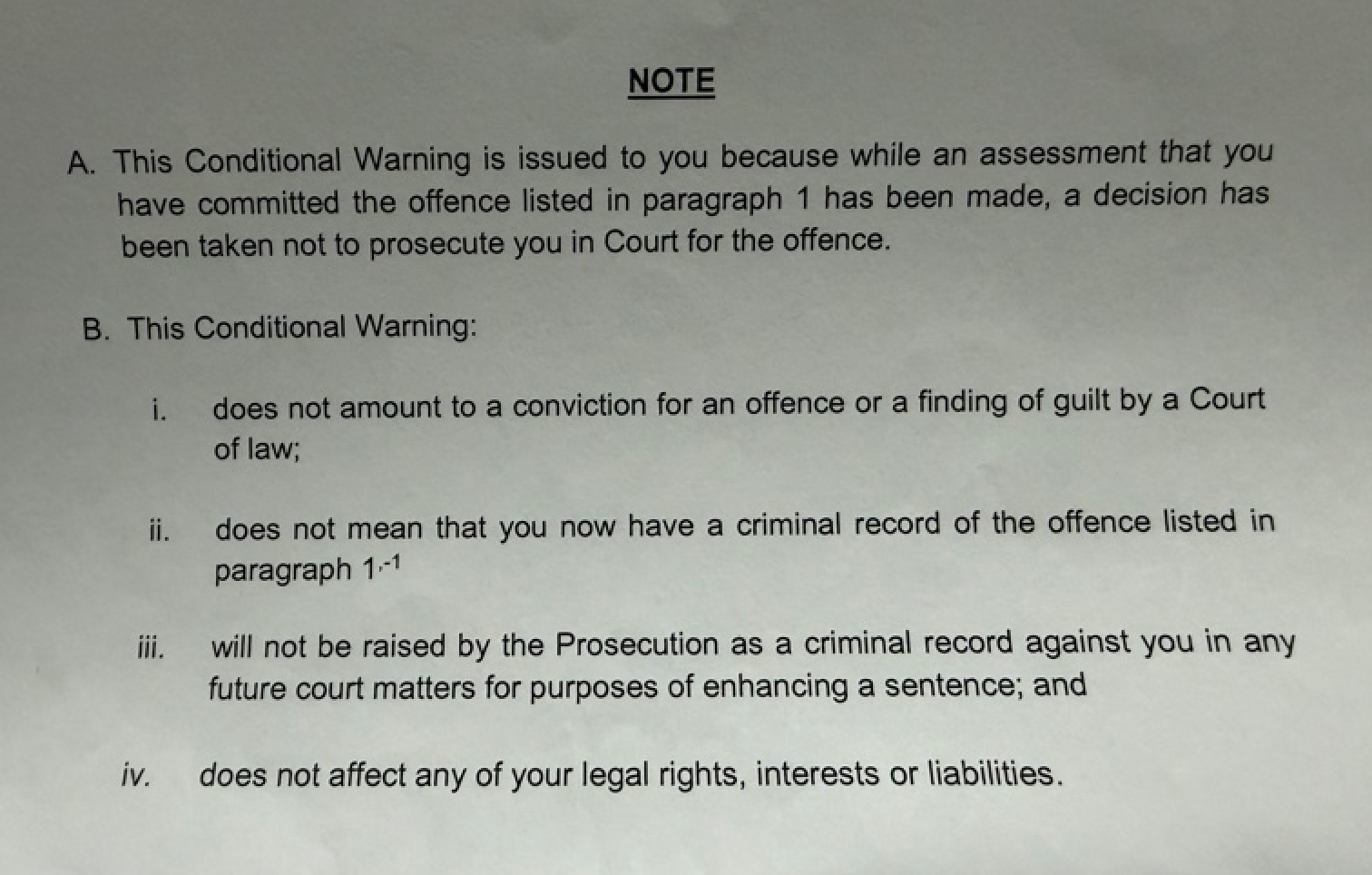
From the stern warnings and conditional warnings that I received on 17 September 2026.
Secondly, the reference to "obstruction of course of justice under Section 204A(a) of the Penal Code on 29 March 2022 and 26 April 2022" is just plain wrong. The stern warning I received was not for obstruction on two occasions but just one, when I was questioned by the police on 24 June 2022. It's printed quite clearly on the warning letter I was given on 17 September this year. (For more on what this obstruction issue was about, refer to my previous newsletter.)
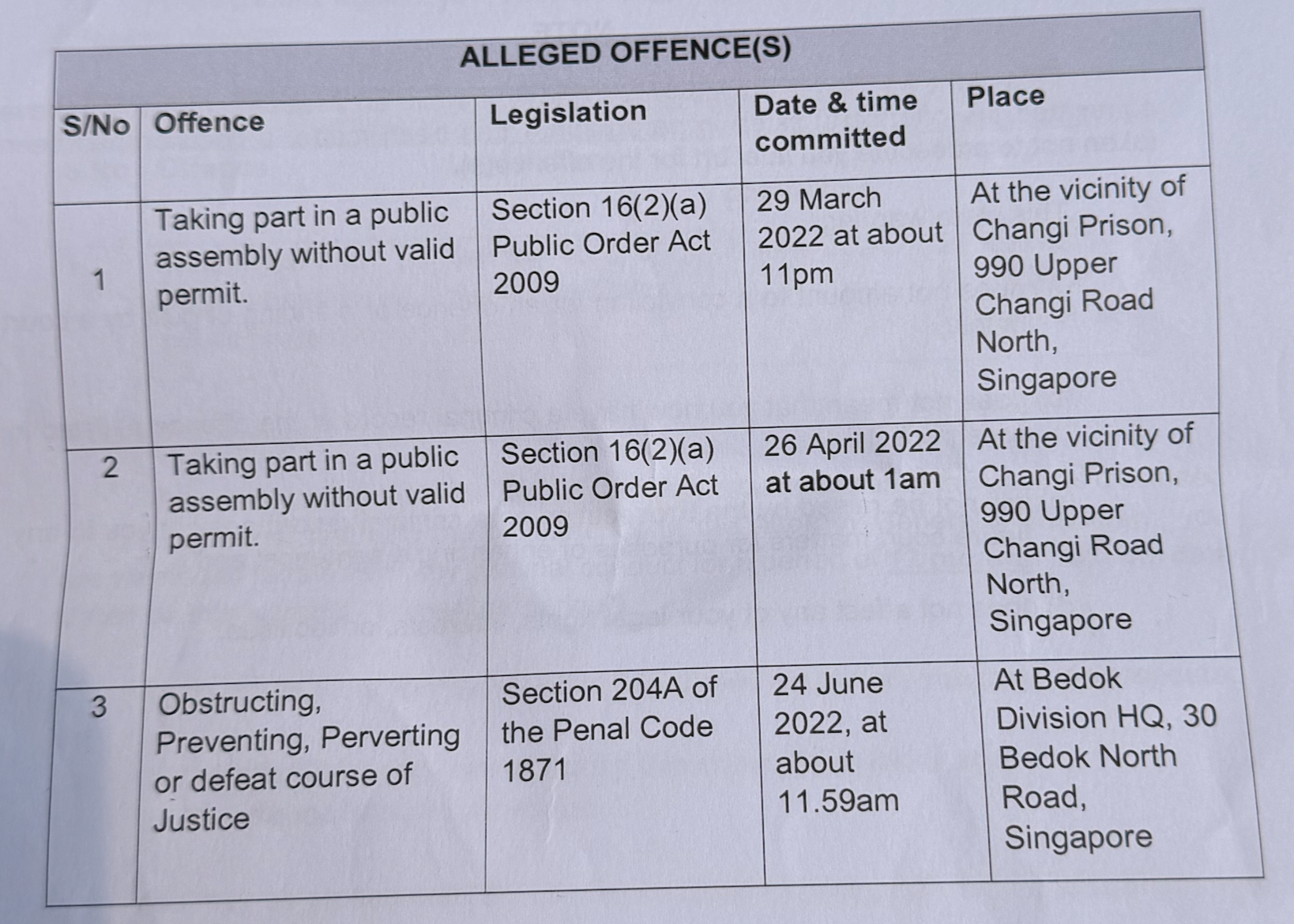
Thirdly, the police statement, and subsequent media coverage, makes it sound like I was warned repeatedly in the past, yet still persisted in participating in an illegal assembly outside the State Courts in February 2025. I did receive a stern warning way back in 2018 for attending a vigil in 2017, but the warnings for the incidents in 2022 and 2024 that the police refer to in their release were served to me on the same day they charged me for the State Courts "assembly". I had no idea about these particular warnings at the time I was in the photos taken in February 2025.
Unfortunately, only the government can issue POFMA directions. And I don't see them wanting to correct this any time soon.
Thank you for reading this special issue!