
My brain hurts and I want to pretend that it's because I have been working too hard but it's actually probably because I've had too much screen time skim-reading/scrolling fanfiction (as a way to escape/self-soothe) until my eyeballs begged for mercy...
I was going to write this one more like a regular wrap with multiple topics, but then I went so long that I ended up cutting the other stuff.
I don't know what brought it on, but it's charges-and-warnings season in Singapore right now. As mentioned in last week's wrap, six people were charged in court last Wednesday (on top of Jolovan Wham's court mention for five new charges last Monday). The authorities didn't stop there: on Thursday morning, the police told Kokila Annamalai, Neo Swee Lin, Lim Kay Siu, and I that we're getting charged for "taking part in a public assembly within a prohibited area", because we'd posed in group photos outside the State Courts in February 2025 after one of Jolovan's court mentions. Another person was slapped with the same charge on Friday, and I've heard of others being summoned by the police to the station to receive warnings for their involvement. Here's one of the photos we took:
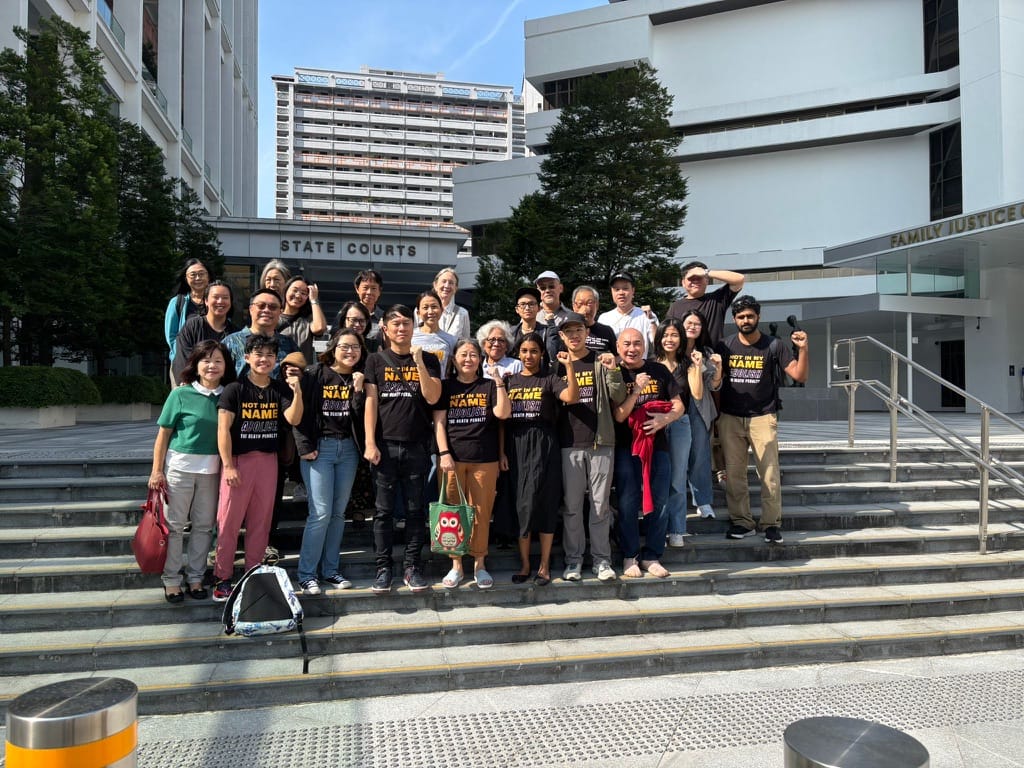
According to the authorities and their interpretation of the ridiculously broad Public Order Act, this is an illegal assembly in a prohibited area. Back in 2022, Jolovan was convicted of participating in an unlawful assembly simply for posing for a photo with an A4 sign outside the State Courts—an act that took all of 15 seconds. There is no bottom to this barrel of absurdity.
I expect that the argument is that the so-called offence isn't about taking photos—because that would be stupid, right?—but because we had a 'cause' or 'message' or 'agenda' to communicate, whether through coming together to take the photo, the way we were posing, or the T-shirts some of us wore. But... so what? What's so wrong, so dangerous, so harmful about wearing T-shirts or wanting to do something collectively? What's so awful about caring about a cause or having a message to communicate?
Singapore has never been great at respecting our fundamental rights to freedom of expression and assembly, but what we're seeing is a clampdown to extreme, ludicrous levels. The Public Order Act is supposed to be about preserving public order and safety, but it's blatantly clear that the threshold is not about the presence or credible risk of harm or violence or damage or danger. None of the activities that have resulted in Public Order Act charges recently hurt or endangered anyone. Instead, it's about where people were, what they were wearing, what symbols they were displaying, what they believe in and how they communicated that in public space. Singaporeans are being penalised for gathering to mourn outside the prison ahead of an execution, for flying kites honouring dead Palestinian children, for arranging shoes in a memorial to students killed in Gaza, for wearing matching T-shirts expressing the view that capital punishment should be abolished.
A society is impoverished when it's people aren't allowed to stand for anything on their own terms; when they're only allowed to express opinions through highly regulated, highly filtered "proper channels"; when everything is forcibly shoved out of the public eye so that those with the most power and privilege can remain comfortable in their artificial notions of harmony. We remain collectively emotionally immature and suppressed if we treat even the tiniest inkling of potential dissent, conflict, or tension as something that needs to be immediately stamped out, allowing only the government the right and the space to make pronouncements. It's clear to me that many Singaporeans care deeply about the country and the world that we live in, and we shouldn't be punished for acting in accordance with our conscience and convictions.
Apart from the charge I received, I also got a few warnings. Some of them pertain to things that happened all the way back in 2022, and that the police have sat on all this time—further proving that none of this was threatening or dangerous or harmful enough to require urgent intervention.
I don't think warnings are worth the paper they're printed on, really—they're not legally binding and are just "opinions" of the police or prosecution. Still, I'd like to list them here for the sake of completeness, and also because two of them touch on something I'd like to raise (and don't think will get attention elsewhere).
STERN WARNING: "Taking part in a public assembly without valid permit" x2
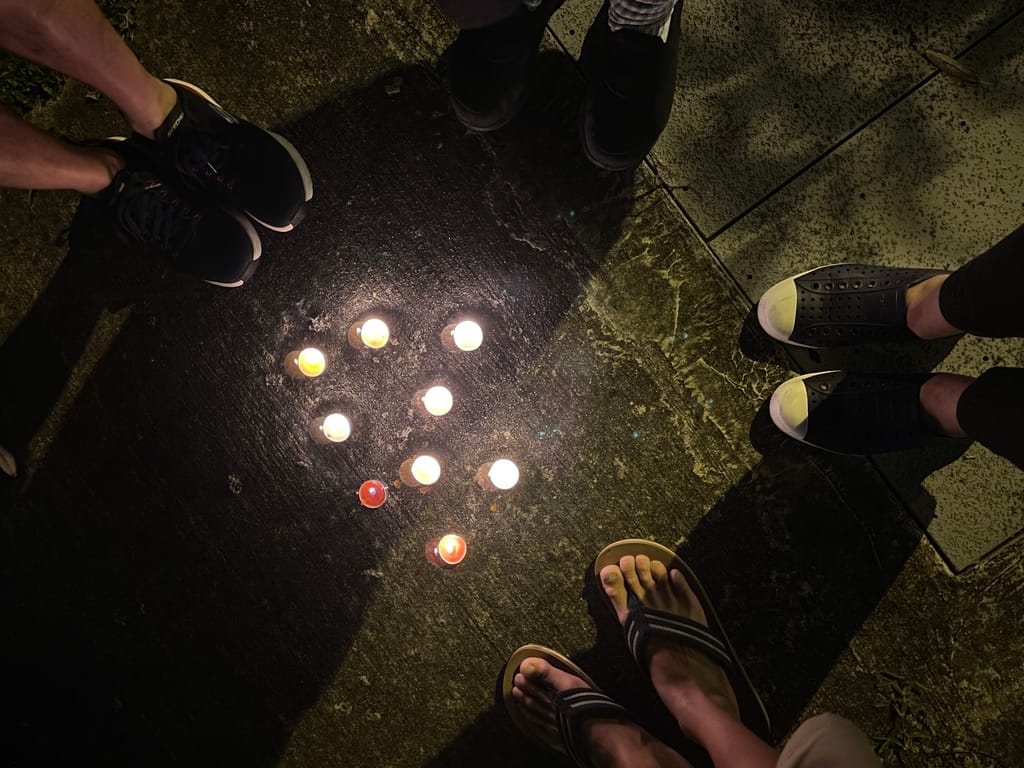
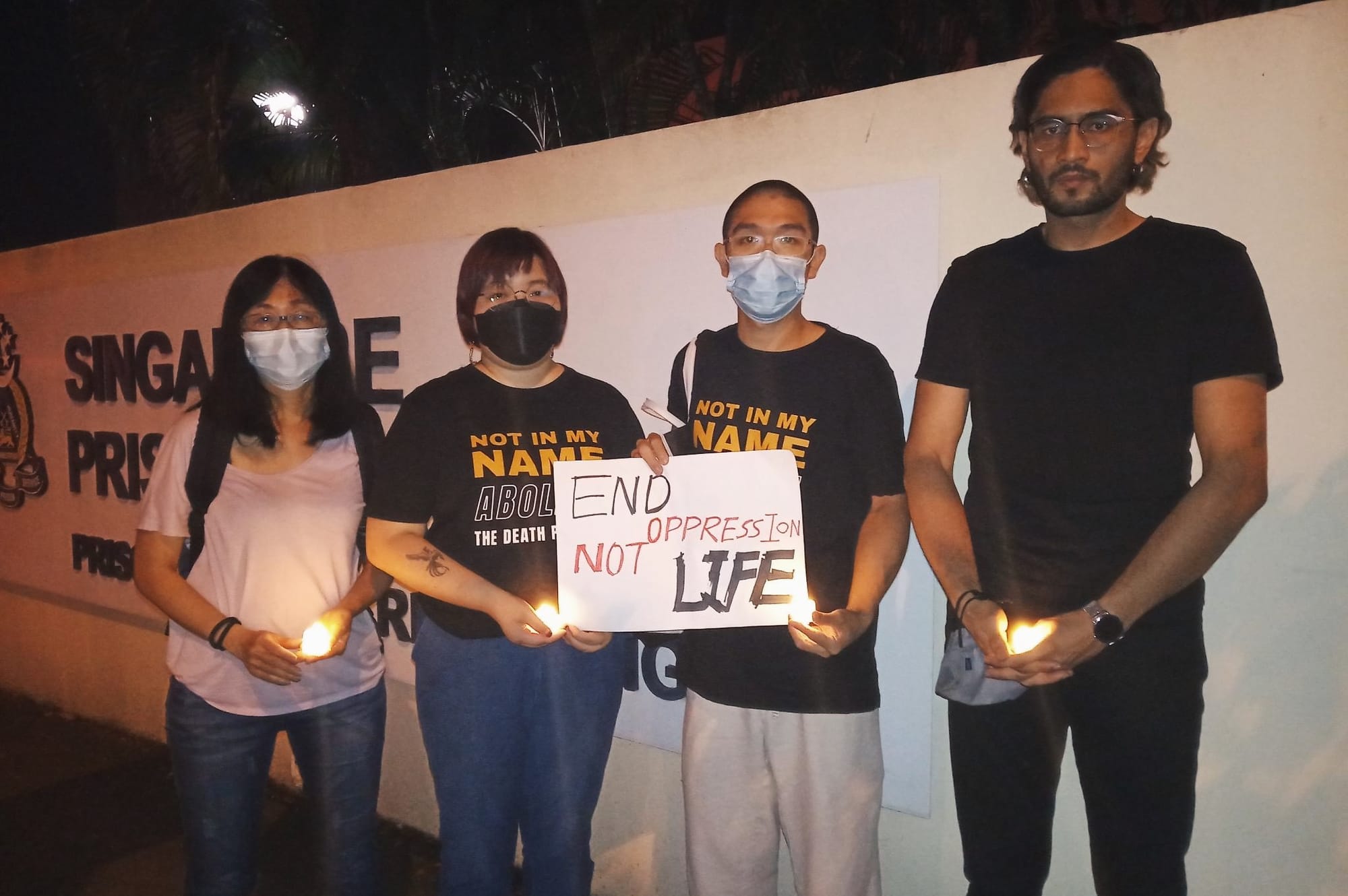
L: March 2022, R: April 2022
In March 2022, the night before Abdul Kahar bin Othman became the first person to be hanged in Singapore in two years—starting a bloodbath that's still continuing today—three friends and I lit some tea lights and sat outside Changi Prison. We alternated between chatting softly and contemplative silence, and were there for less than an hour.
In the early hours of 26 April 2022, before Nagaenthran K Dharmalingam was executed at dawn on 27 April, four of us stood outside Changi Prison and posed for photos while holding electric candles and an "End Oppression Not Life" sign. We got there, took a few snaps, and left.
STERN WARNING: "Obstructing, preventing, perverting or defeating course of justice"
In June 2022, as part of their investigation into the two "assemblies" mentioned above, the police not only confiscated my phone but also asked for the passwords for my Facebook, Instagram, Twitter, WhatsApp, and email accounts. I said no.
I remember it not being an easy decision to make—especially warned that refusal could be interpreted as obstruction of justice, which carries the potential punishment of jail time and a fine—but it was a simple one. I am a working journalist. I use my various social media platforms, WhatsApp, and email to communicate with people all the time. Sometimes what we chat about is on record and ends up in published stories; other times, it's either off-the-record or on background, or there's a legitimate reason for anonymity, or it's an exchange that took place but didn't end up going anywhere. Regardless, I have a responsibility to protect my sources to the best of my ability, to honour and maintain the trust that I've built with people that, if they reach out to me, our conversations aren't going to suddenly or randomly end up in the hands of a third party—including (or especially!) the police.
CONDITIONAL WARNING (12 MONTHS): "Taking part in a public assembly or public procession"
In June 2024, a group of about 40 students walked from Novena MRT to the Ministry of Home Affairs to deliver letters they'd written expressing alarm at the proposed Maintenance of Racial Harmony Bill (which has since been passed in Parliament and came into force this week). They were worried that this law could be used against people speaking up about Palestine and advocating for an end to genocide. Some of them put on T-shirts saying "THERE ARE NO MORE UNIVERSITIES IN GAZA" in a show of student-to-student solidarity between Singapore and Palestine.
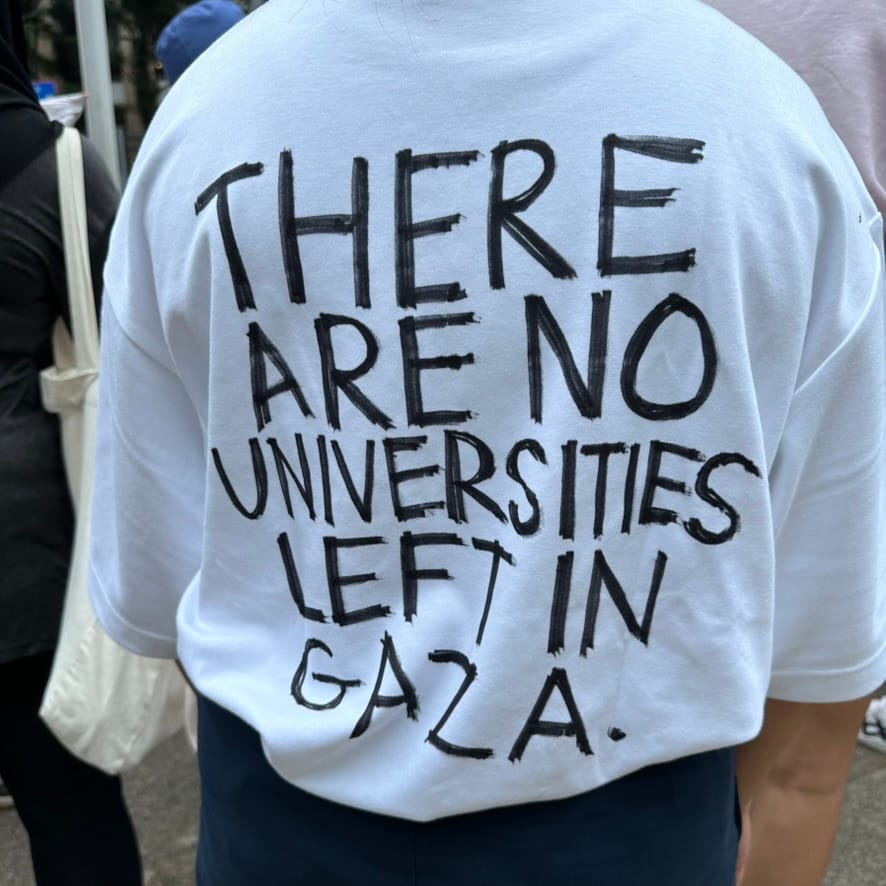
They reached out to ask if I would be interested in writing about them for this newsletter, so I followed them on the walk and wrote about it in the next weekly wrap:
 Kirsten Han
When we reached MHA, there was a guy across the street taking photos of the students, but he didn't identify himself. I later realised that he was a Straits Times photographer, and that there had been an ST reporter at Novena MRT who had quietly taken photos of the students. But as far as I'm aware, I was the only journalist on the day who identified myself and spoke to the students about what they were doing and why.
It's a relief not to have been charged for obstruction of justice and another Public Order Act 'offence', of course, but those last two warnings are important to me because of their relevance to journalism. It shouldn't surprise anyone that there aren't clear protections for journalists in Singapore. Official media accreditation, for instance, is up to the discretion of the government, so they have control over who they recognise as journalists, and there's differentiated treatment between local mainstream media, reporters for foreign news outlets, and independent journalists. There's no recognised journalistic privilege of source protection (which exists in some countries and also in international law), and even though I was covering that MHA letter delivery action as a journalist I was given a warning as if I were a participant. (That said, I do recognise that if I had got charged for this, my defence could conceivably be that I was only there to report—but my point is that journalists shouldn't have to risk being charged for doing their jobs in the first place.)
Of course, these are very small beans examples of the lack of media freedom and protections for journalists in Singapore. I've thankfully not been charged for these two alleged offences, and there are obviously many journalists around the world who are in far worse situations. But I thought these warnings provided an opening to reflect on the relevance of journalist protection to society as a whole.
The lack of such protections makes it more difficult and dangerous to do the sort of journalism that really holds the powerful to account. For example, because there's no clear whistleblower protection or source confidentiality, it's less likely that people would be willing to talk to journalists if they knew of any wrongdoing going on, which makes it even more challenging to do investigative reporting. This means that the press are less able to perform their watchdog role—which, admittedly, the Singapore government rejects in the first place (that the local mainstream media itself rejects this is much more embarrassing). But Singaporeans should think about what we want and expect from the local press corps, and whether we would like the press to demand transparency and hold powerful people accountable regardless of whether the ruling elite like it or not.
Thank you for reading this issue! If you'd like to support We, The Citizens, please consider becoming a Milo Peng Funder by getting a paid subscription. You can also gift someone else a subscription, or leave a tip (in SGD).
If you're not ready for a paid subscription, you can still support the newsletter by sharing it online and helping me get the word out!
Music for the weekend! When the world sucks but you're still in lurve: "The world's on fire, I burn / Happily dancing with you"