
Happy Valentine’s Day to everyone who cares about Valentine’s Day! 💝💝💝
Just for fun, last week I popped a little poll into the newsletter asking you what you think should be done with ministerial salaries. Here are the results from the 28 people who responded:
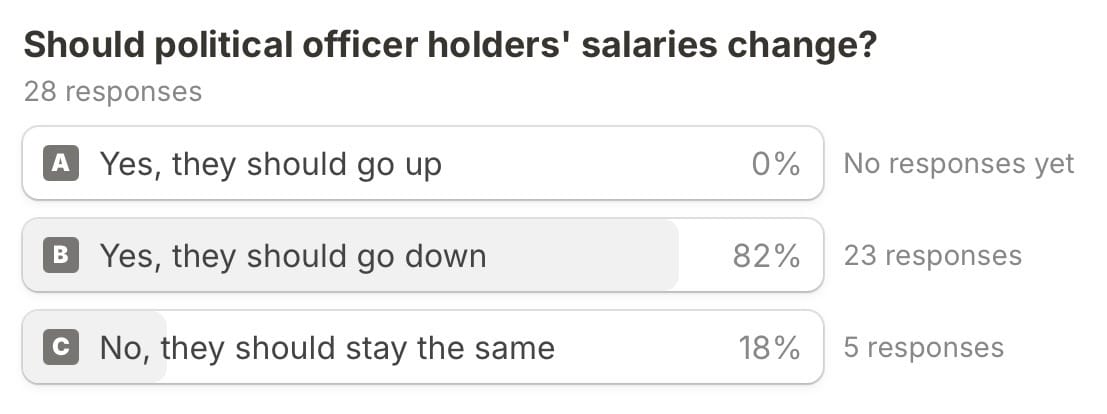
I’m not sure the ministers are going to be very happy with this result. I also get the feeling that at least 23 people are going to be very disappointed when the final decision is made. But we probably were already expecting that.
What did you guys think about polls, anyway? Fun to have? Irritating? I’m undecided about whether or not to try to incorporate more of these things in the newsletter.
(1)
Lingkesvaran Rajendaren, a Malaysian national, was executed for a drug-related offence on Wednesday afternoon. Before his execution, Lingkes had filed an application seeking declarations from the court that prison officers had mistreated him. He then filed for a stay of application, so that he could see this case through.
The day before his execution, Justice Woo Bih Li dismissed his application for a stay without addressing the veracity of Lingkes's claims of mistreatment—instead, the judgment was focused on why Lingkes hadn't filed that application earlier, before concluding that it was an "abuse of process" to try to delay his execution. Rocky Howe has written an analysis of the ruling, which you can read here.
Looking through the judgment, I was really struck and horrified by this bit (emphasis mine):
In Pannir Selvam (PACC Application) at [59], the Court of Appeal held that PACPs are persons who have been sentenced to death in accordance with law and whose convictions and sentences have been upheld by the Court of Appeal following an appeal or review. Consequently, the starting point in the circumstances is that the State is entitled to deprive them of their lives, subject to the qualification that this must be carried out in accordance with law. Though the carrying into effect of such a sentence will necessarily prevent a PACP from seeing through any pending proceedings which he may be interested (including proceedings which are brought by him and may require his testimony), this is not intrinsically objectionable, as PACPs stand in a very different position from other persons who have not lost their right to life by reason of a lawfully imposed death sentence. In short, PACPs have their rights lawfully attenuated and any proceeding which does not affect the legality of the conviction or sentence or come within a limited exception of State-brought proceedings is not a relevant pending proceeding to obtain a stay of execution.
(2)
This week’s big news is, of course, the Budget. Every year, the Budget gives us an idea of where the government’s priorities and direction. It also provides a treasure trove of data to delve into and how the various ministries, state organs, and agencies have been spending money.
If you want to look up what you might be getting out of the Budget, here’s a calculator tool courtesy of CNA.
My ’favourite’ things to look up
Because I’m me, I always look up the Ministry of Home Affairs’s budget estimates. For the financial year of 2026, their drug enforcement budget is $264,176,900. Meanwhile, the prison budget (or “Offender Management and Rehabilitation Programme”) is $856,439,700.
Last year, I was part of a team from the Transformative Justice Collective that looked at the Budget to get a sense of how much Singapore spends on the war on drugs. Check out our post here. The budgets for both drug enforcement and prisons in FY2026 are even more than what was estimated for last year.
This year, we’re seeing more CDC vouchers and a special Cost-of-Living payout for citizens residing in Singapore aged 21 and above, who don’t own more than one property, and earn up to $100,000 in assessable income. I enjoy a good voucher as much as any Singapore—and have gleefully used my vouchers on some very satisfying tze char that saved me from having to make one of my lazy, hit-and-miss rice cooker experiments—but I wonder about them becoming a fixture of Singaporean life. Vouchers are fun if they are a bonus, but if they become essential because many working class households need them to put food on the table and keep their head above water in an expensive city like Singapore, then surely it’s a sign that we need to look at more systemic and structural ways to address poverty and inequality.
One other thing that stood out in this year's Budget: Singapore is going to lean into AI. Prime Minister Lawrence Wong himself will chair a National AI Council to "drive Singapore's AI agenda". The focus will be on four sectors: advanced manufacturing, connectivity, finance, and healthcare. A new AI park will also be developed in one-north, and a scheme supporting businesses in the adoption of AI will be enhanced for the next few years.
I'm not a big fan of AI—especially generative AI—but I accept that it would be unrealistic for Singapore to ignore or boycott it. I might not use it myself, but I think it's inevitable that there will be adoption and use, and recognise that there are some use cases in which AI is genuinely helpful. But I'm wary of how tech optimistic Singapore usually is, without there being enough space for discussion about consent, privacy, safety, and ethical use. How much opportunity will there be for Singaporeans to talk about the trade-offs or issues like the environmental cost of AI? It's not as simple as "AI or no AI"—the how of implementation is important, too, so we'll have to keep an eye on how the National AI Council navigates these issues.
(3)
If you're a blind box–collecting smoker, this is not a good time for you. Singapore is going to regulate the sale of blind boxes to address concerns related to gambling. The Ministry of Home Affairs and the Gambling Regulatory Authority have decided to introduce conditions on the sale of blind boxes, which will be made known once they're finalised. Meanwhile, there's a 20% tax hike on cigarettes and other tobacco products, in the hopes that making those fire sticks burn a bigger hole in wallets will encourage more people to quit.
(4)
I'm not on TikTok (I've accepted that I'm old), so I've been slow to the uproar over an Iranian content creator claiming that Singapore is the "most toxic city" to live in. I can see how this sort of statement would get people's hackles up and make Singaporeans defensive, but then I came across these screenshots in which she lists her reasons for saying so:
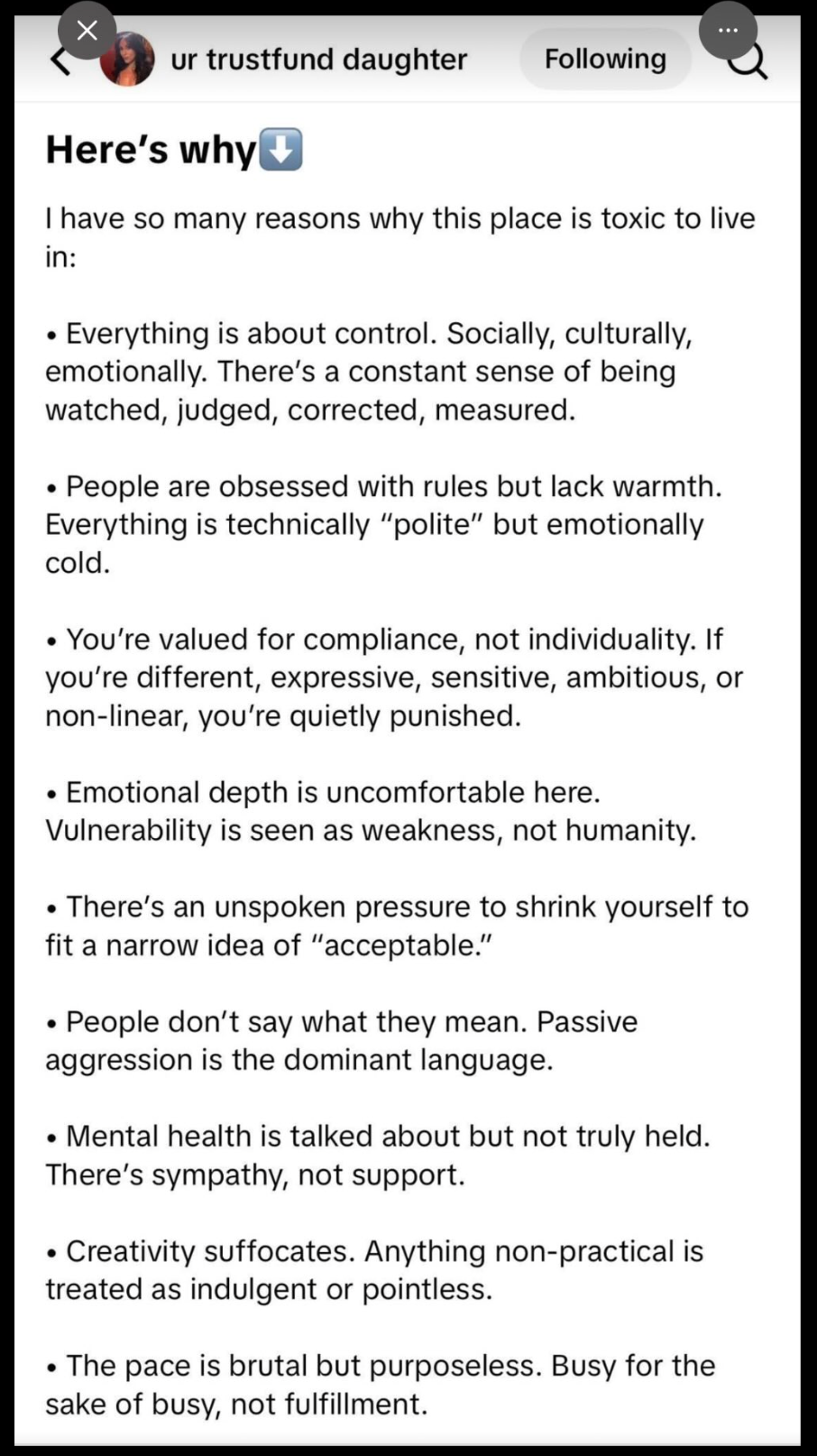
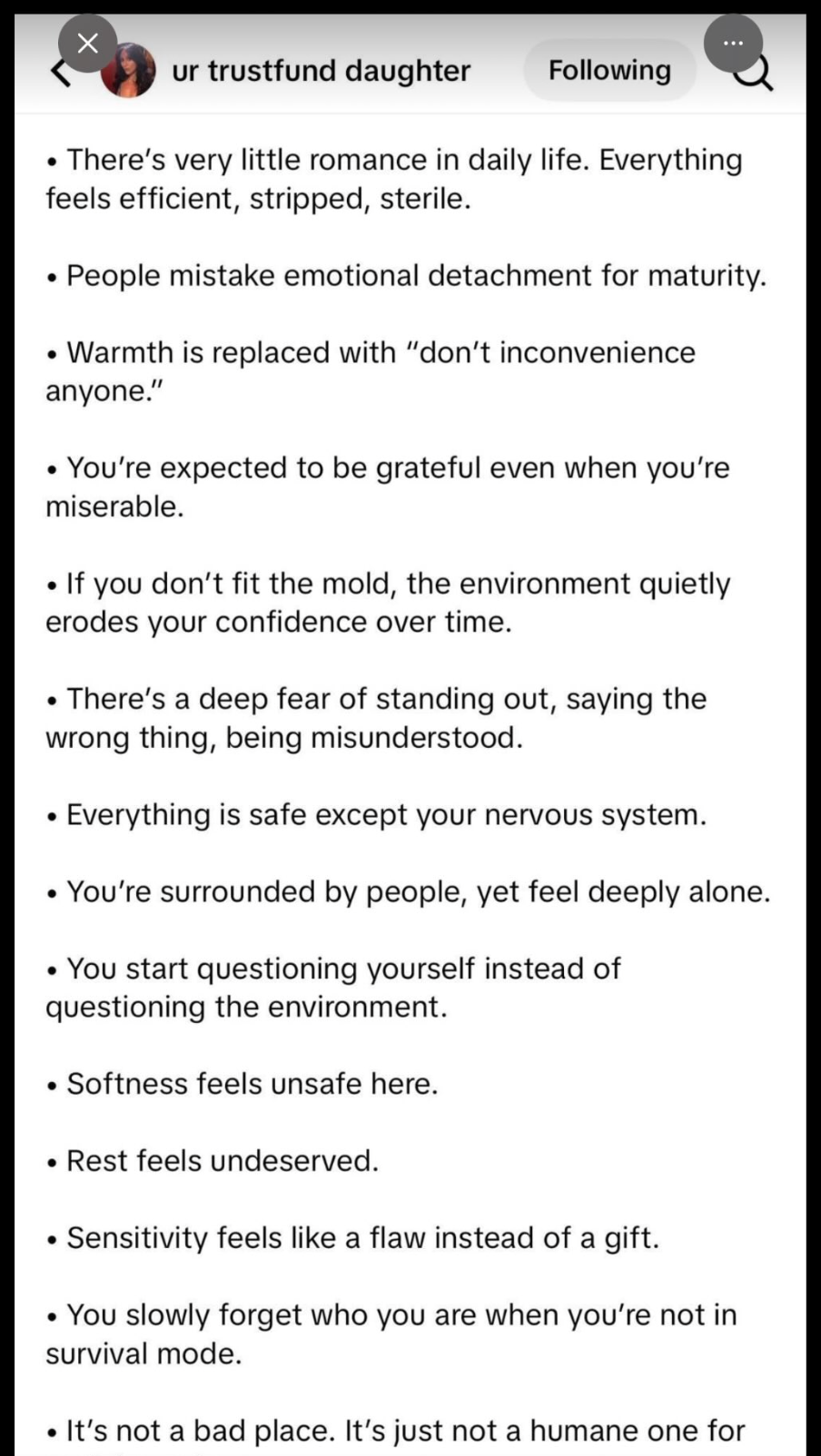
Do I think Singapore is the most toxic city in the world? No. But many of the points she makes in those screenshots do resonate. (Heck, I've spent multiple therapy sessions just on the "rest feels undeserved" bit.) It doesn't mean that this is a totally accurate representation of Singapore—it's still a generalisation based on one person's experience—but I think we do ourselves a disservice if we, in a rush to defend our country's honour, refuse to acknowledge that there's some truth in these points.
There are many pockets of spaces in Singapore where it doesn't feel like what's she describing, but these are often spaces that we have to seek out or actively co-create, and often they're made precarious or come under threat because of political repression or, perhaps even more often, plain ol' capitalism and "market forces". There are systemic and structural factors at play that disincentivise and control free expression, creativity, and the joy that comes from a sense of possibility that isn't bogged down by KPIs and goals and the need to make money to stay afloat. Recognising this doesn't mean we conclude that Singapore sucks. Instead, it's an invitation to think about whether this is the sort of environment/society/country we want to live in, and what we're willing to do to create the changes we want to see.
Thank you for reading! As always, feel free to forward this weekly wrap to anyone you like, and spread the word about this newsletter!