
Greetings from Scotland! Scotland always feels peaceful and safe to me; meanwhile, the Tartan Army have gone off to the US for the World Cup, where they're apparently drinking Boston dry. As they're saying: "No Scotland, no party" 🏴 ⚽️
Who are you cheering for in the World Cup? I ask this as if I've been following the World Cup.
(1)
Singapore generates a lot of waste and we are bad at recycling. This probably doesn't come as a surprise to many of us; at this rate, we're not going to hit the official goal of a 70% recycling rate by 2030. Other bad news: Pulau Semakau, Singapore's only landfill, is projected to run out of space by 2035.
The government now says that they're going to review the Zero Waste Masterplan and the targets for recycling and reducing waste. This review is also going to include an examination of the blue recycling bins we see around the city. The success of these bins have been mixed—since 2017, they've had a contamination rate of about 40%, which messes with the ability to recycle what's in the bins.
Experts say that the review should focus on how to nudge people to convert their knowledge about recycling into action, rather than on punitive measures like fines. Perhaps segregated bins—encouraging people to sort their recyclables at home rather than dumping everything in one big dumpster—might work better? Recycling behaviour needs to improve on a collective level, so as to reduce the amount of contamination that occurs.
(2)
What do we need to ensure that persons with disabilities can access justice? Pro Bono SG, the charity arm of Singapore's Law Society, launched the Inclusive Justice Law Centre in March to support access to justice for persons with disabilities. They work with social workers, psychologists, caregivers and others.
Singapore has such a long, long way to go in this area. I'm curious to see how the Inclusive Justice Law Centre pans out, and what sort of justice facilitation it's able to provide. It brings to mind this special issue that I wrote in 2022 on procedural accommodations and the work done by justice facilitators in Mexico:
 Kirsten Han
(3)
As if there isn't enough shit in this world already, women also have to struggle with image-based sexual abuse (IBSA), which isn't always taken very seriously. CNA has a profile of The Moxie Collective, which started to support women in Singapore who have been victims of IBSA.
If you're unfamiliar with the term, here's a pretty comprehensive definition of IBSA:
Image-based sexual abuse (IBSA) is an umbrella term referring to the nonconsensual taking, creating, or sharing of “intimate” (nude or sexual) images (photos or videos), including threatening to share intimate images with others (“sextortion”), pressuring, threatening, or coercing someone into sharing their intimate images (“sexting coercion”), using artificial intelligence (AI) to create fake or digitally altered, sexualized images (“deepfakes”), and the unsolicited and unwanted sharing of sexually explicit images (“cyberflashing”).
Back in 2024, it was already reported that cases of IBSA were on the rise in Singapore. Between smartphones, the internet, and generative AI, perpetrators have easy access to ways to threaten, harm, and torment their victims—AWARE's Sexual Assault Care Centre have handled their fair share of cases of such technology-facilitated sexual violence.
Such violence often gets downplayed or even dismissed; people might think it's "just on the internet" and not as bad as physical assault. But the impact of IBSA shouldn't be overlooked: it causes real hurt, has real impacts on well-being, and, if not addressed, leaves women feeling constantly unsafe. A community group like The Moxie Collective provides peer support—regardless of whether victims choose to report their abuse or not—and does public education work so this issue gets on Singaporeans' radars.
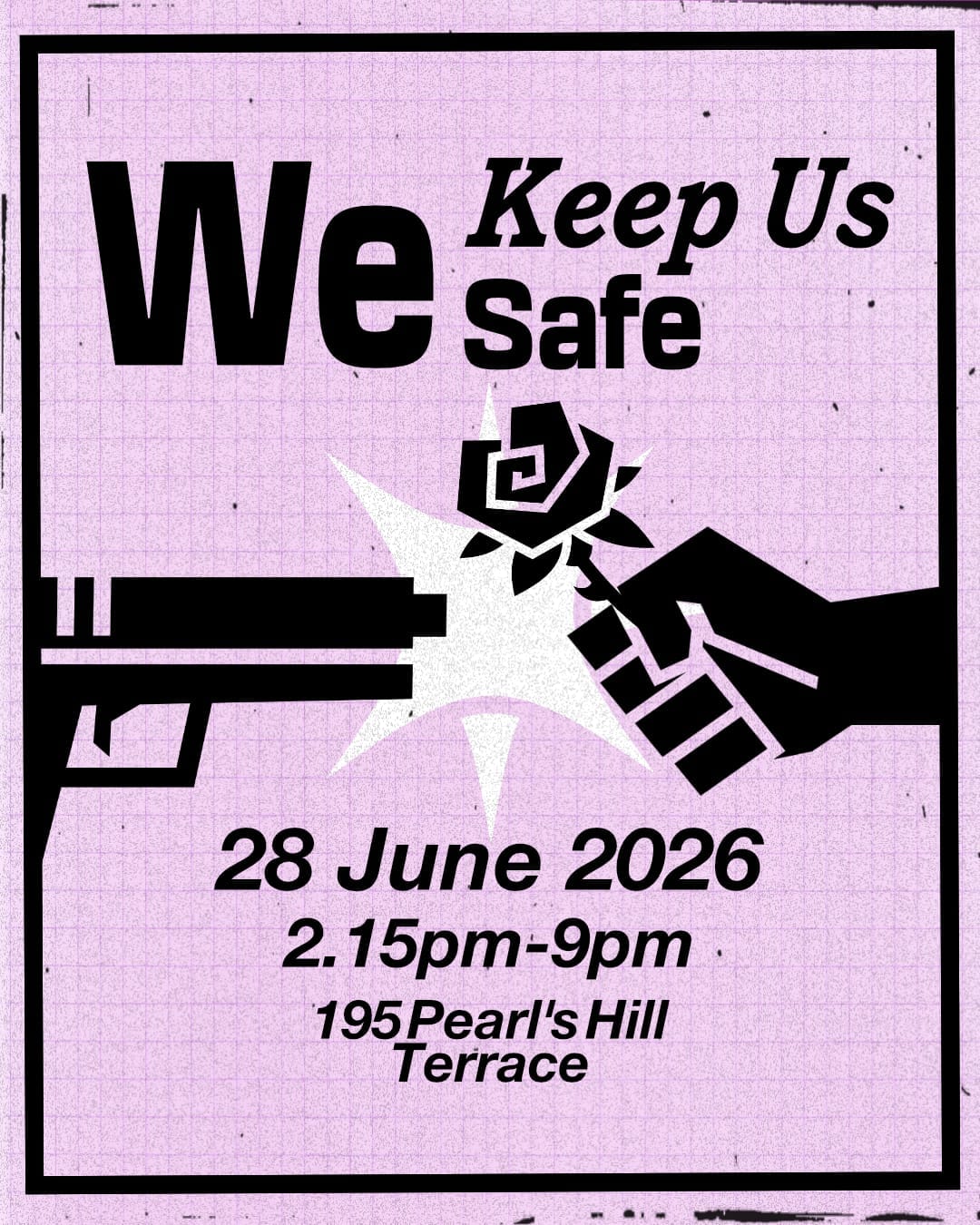
The Transformative Justice Collective is thrilled to bring 'We Keep Us Safe', a day of activities pulling focus towards the need to build strong communities from the grassroots, allowing us to rely on one another rather than hand power and control to an authoritarian regime.
Thank you for reading! As always, feel free to forward this weekly wrap to anyone you think might be interested, share the web link on social media, or spread the word about this newsletter!
Music for the weekend! Since I'm in Scotland: