
Crawled out of bed with a bit of a sore throat and a headache after sleeping for more than 10 hours, only to find that the cats had left a dead cockroach outside my room for me. It's fine, it's all fine, I was totally calm and collected about it. I'm just grateful they didn't think to put it in my bed.
(1)
Kokila Annamalai was charged under Section 15 of the Protection from Online Falsehoods and Manipulation Act on Thursday. She had refused comply with a Correction Direction issued on the order of K Shanmugam in 2024, which POFMA states is a criminal offence that can be punished with a fine of up to $20,000, imprisonment of up to 12 months, or both.
Kokila told the court on Thursday morning that she isn't ready to enter a plea, and that she's still in process of engaging a lawyer. The judge scheduled a pre-trial conference for 14 May.
Back in October 2024, Kokila wrote about why she'd chosen to defy the Correction Direction. It's worth reading her statement again, especially since it's unlikely that the mainstream media is going to be giving her much space to articulate her thoughts on the matter.
 Kokila Annamalai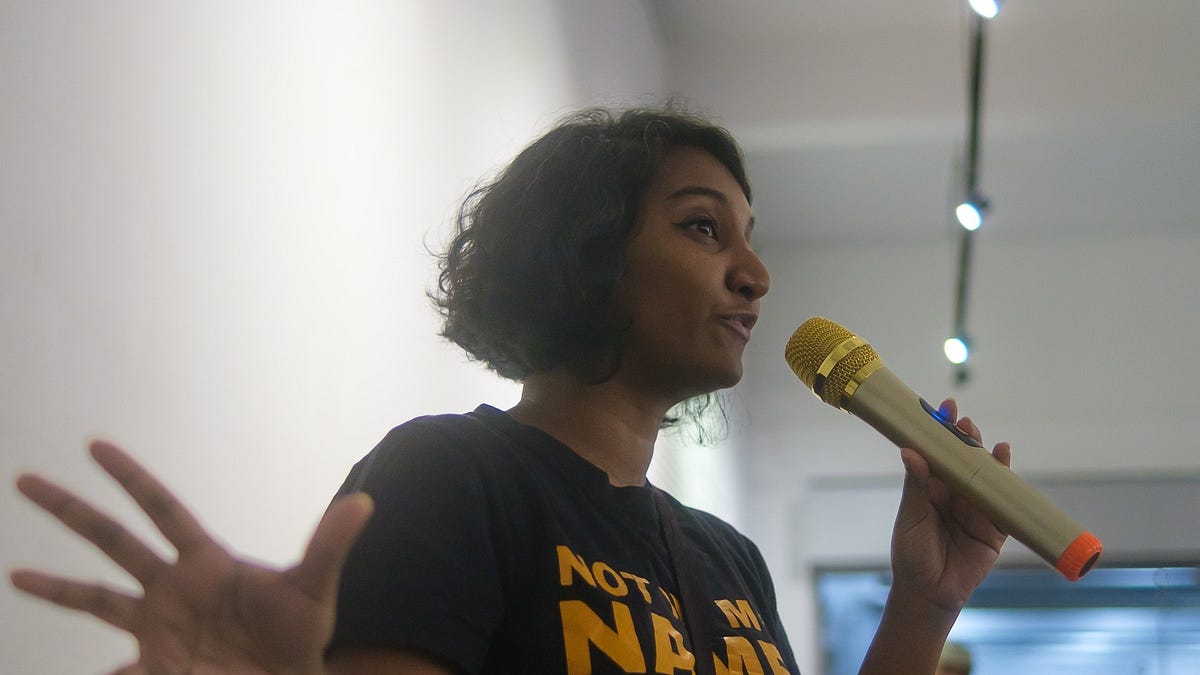
Kokila is the first person to be charged for defying a POFMA direction. There's no precedent yet for how the courts will determine a sentence for such an 'offence', so her case is an important one to watch.
(2)
The government has blocked six websites that were pretending to be local news websites. They were, in reality, run by foreign actors, and the authorities say they could have been used to mount hostile information campaigns. CNA found that one of them, The Singapore Times, was linked to a Chinese company.
This is a problem that we can't run away from, and it's sadly probably here to stay. The government has blocked these six sites now, but it's only a matter of time before more pop up, if they haven't already. Such sites are easy to set up, and generative AI makes it even easier and quicker to populate them with content that, at first glance, might seem authentic. The internet is filling rapidly with slop, which is damaging in and of itself. Hostile actors don't actually need to seed coherent, false narratives—they just need to flood the space with so much nonsense that everyone is left too confused, overwhelmed, and exhausted to engage in genuine discourse or make properly informed decisions.
What can we do about this? Back in 2018 and 2019, the government insisted that POFMA was desperately necessary to protect us from this disinformation campaigns. They said that the existing laws weren't sufficient to protect Singapore. But these six websites were blocked under the Broadcasting Act, not POFMA. There's really nothing POFMA can do about such sites—who would the government send their orders to? And even if they figured out who to deliver a POFMA direction to, what could they even do if these foreign actors just ignored them? Nothing.
This is not to say that there's nothing we can do, that Singapore should just lie down and let the hostile influence operations just wash over us. Of course not. This is something that really needs to be addressed; it's just that the answer isn't about consolidating more power in the government's hands. We need more media literacy, more scepticism of power, more political education and critical thinking in our society. This isn't something the government is genuinely supporting at the moment, so the next best thing would be to try to figure out for ourselves, within our communities and networks, how we can support one another to learn and practice.
(3)
We're coming up to the end of April, which means Labour Day is fast upon us! This year's Labour Day Rally in Hong Lim Park is co-organised by Workers Make Possible and SG Climate Rally. You can check out their campaign paper for this year for a rundown of the issues that will be covered at the rally this year, including: insufficient time for rest, leisure, and caregiving; the need for higher rates of pay so people don't have to be so overworked; the need for corporations to pay for the pollution they cause.
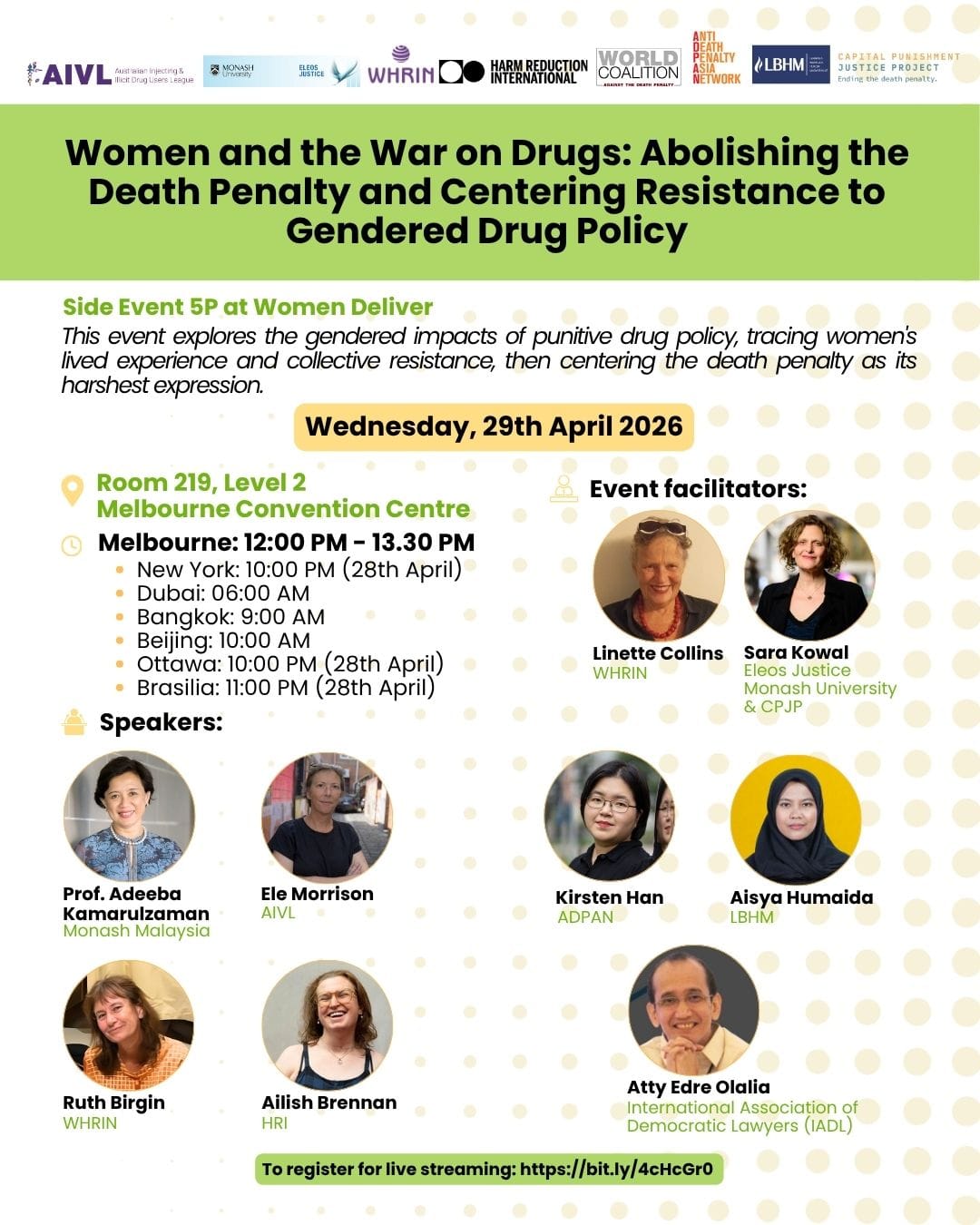
This event explores the gendered impacts of punitive drug policy, tracing women and gender diverse peoples' lived experience and collective resistance. Centring the death penalty as its harshest expression, the event will also focus on women on death row across Asia, calling for abolition and justice.
Advocates will demonstrate how drug policy is gendered and the relevance of a human rights and feminist approach. Examples of leadership and mobilisation of women and gender diverse people who use drugs will be presented. Although funding cuts and anti-gender rights actors pose a significant threat, women and gender diverse people who use drugs are staking their place in the feminist movement.
Despite the use of the death penalty for drug offending being a clear breach of international law, currently at least 56 women are on death row for drug offences. Women on death row are convicted of drug offences at far higher rates than men. Anti-death penalty experts will spotlight the case of Mary Jane Veloso, a Filipino domestic worker who was sentenced to death despite compelling evidence that she was unaware of being in possession of drugs and was in fact a victim of human trafficking. Drug policy is a feminist issue.
Register here to attend online.
Thank you for reading! As always, feel free to forward this weekly wrap to anyone you think might be interested, share the web link on social media, or spread the word about this newsletter!