
I'm in my Reading Era at the moment; specifically, reading on my phone, which is distinct from my Reading Era (on Kobo) and my Reading Era (physical books). Apart from Heated Rivalry I haven't watched any TV shows or films in weeks, but I've been reading thousands of words a day across fiction, nonfiction, and fan fiction. I regret nothing.
(1)
A pet topic of many Singaporeans: ministers' salaries. The salaries of political office holders were due for a review in 2023, but that was deferred "given the uncertain external environment, and the downside risks in the global economy at that time". This year, the government has convened an independent committee to carry out the review. It'll probably be a little while yet, because the committee was just formed; when ready, they'll submit a report recommending "appropriate salary levels" and, if needed, tweaks to the salary framework.
As a refresher for us all: the usual annual salary of an "entry-level" minister is $1.1 million. This is made up from two components: fixed (65% or about $715,000—from monthly salaries and a 13th-month Non-Pensionable Annual Allowance) and variable (35% or about $385,000—from bonuses and an Annual Variable Component).
We'll have to keep our eyes peeled for the committee's report and see what their conclusions are. Political office holders' salaries haven't changed since 2012. I wonder if they'll change now, and what the public reaction will be.
I'm going to experiment with a little poll here:
(2)
One final salvo against Pritam Singh and the Workers’ Party. At least, I hope this is the final salvo, because this drama has gone on for about 35 seasons and we don't need more.
Since Singh is no longer the Leader of the Opposition, his (literal) seat in Parliament has been changed so he doesn't sit directly across from Prime Minister Lawrence Wong anymore. Christopher de Souza, one of the deputy speakers of parliament, is now the one with the privilege of getting to stare at Wong's lovely mug in the House.
Chan Chun Sing, the coordinating minister for public services, says the government is open to institutionalising the LO role—as opposed to leaving it to the prime minister—but that it would be "appropriate to allow these conventions [related to the scope of the LO role and how it operates] to further develop and mature, so that any eventual codification in statute is informed by established and sound practice".
My question would be: what's so hard about codifying the role with its current responsibilities and privileges now? This office was introduced in 2020—is five years not enough to have enough experience of how things work to codify the role now? It's not like this is something the PAP has to work hard to sell: they have the overwhelming majority in Parliament and don't have to convince any other party to come on board to pass any legislation. They don't have to agree "in principle"; they can just get it done. Goodness knows they've done this on many other occasions.
(3)
The internet is awash with slop and scams. In late January, the Singapore police sent an order to Meta under the Online Criminal Harms Act, telling the company to use enhanced facial recognition and prioritise reviewing end-user reports to target scammers on Facebook. If Meta doesn't comply with the order, they could be fined up to $1 million, or up to $100,000 daily in the case of a continuing offence.
Scammers aren't the only problem. Deepfakes and other AI-generated misinformation are pouring into online spaces. Zaobao reports on a wave of Chinese-language, AI-generated content (article in Chinese) making claims about Singapore's decline and Lawrence Wong being put under pressure, or even ousted, by PAP infighting. These videos are cheap, easy, and fast to make and can be widely disseminated without much effort. They might not convince everyone, but they don't need to—they just need to get the group of people who might be predisposed to believing them to dig into that position further. It's not very clear to me how POFMA—which was justified as necessary to fight hostile disinformation campaigns like these—will actually work here. Who will they POFMA? If these are being made and disseminated abroad, how can the authorities ensure compliance? If there's a hostile foreign state actor behind it, what can Singapore do if they don't give a shit about a POFMA order?
The people's Labour Day Rally will be back again on 1 May 2026 at Hong Lim Park, 3pm–7pm! This year, it's co-organised by Workers Make Possible and SG Climate Rally:
Singapore ranks as one of the most overworked countries in the world. From doctors to domestic workers, security guards to tech workers, platform workers to cultural workers, most workers who toil on this land are running out of time for themselves as they give most of it to work. Similarly, every coral bleached and green space lost is a reminder that we are simply running out of time to protect our planet. If you're a burned out worker on this burning planet, and you aspire for more time for life, this rally is exactly for you. We don't have much time left. Our time is NOW.
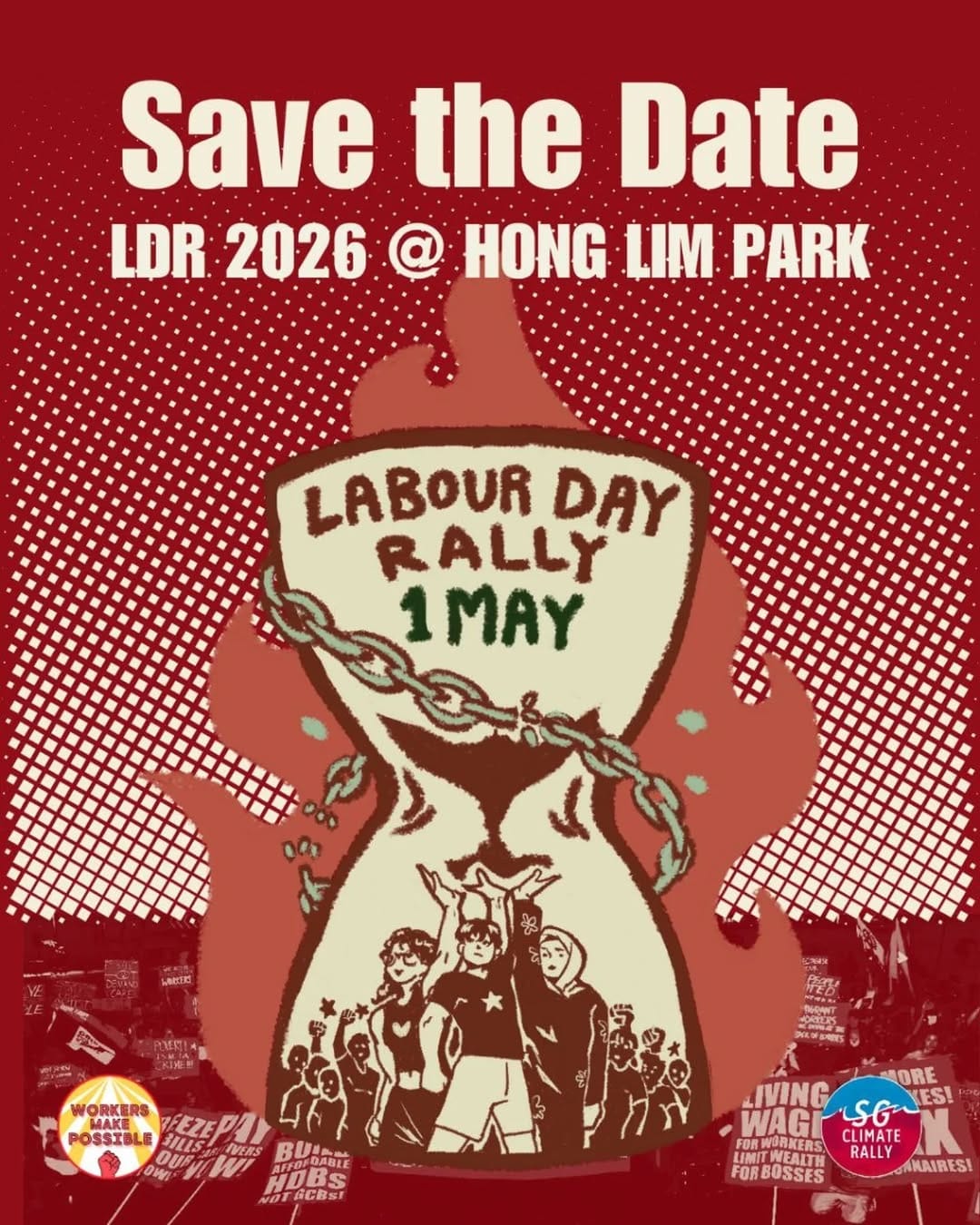
Mark your calendars! I'll be there, most likely at the NIMBUS booth ready to talk people's ears off about freedom of expression and media freedom, but also about how those of us in the independent media space are workers, too.
Thank you for reading! As always, feel free to forward this weekly wrap to anyone you like, and spread the word about this newsletter!